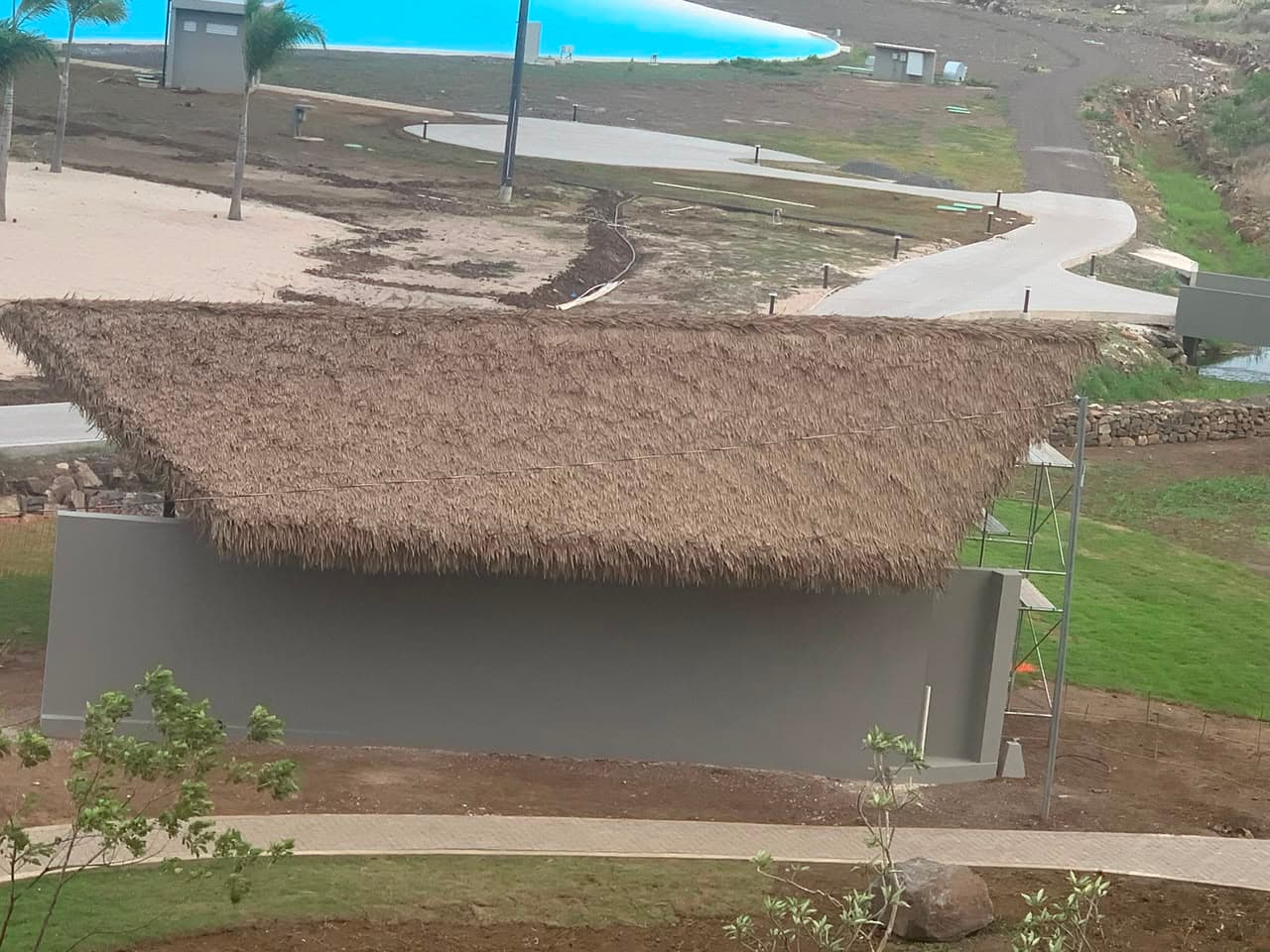
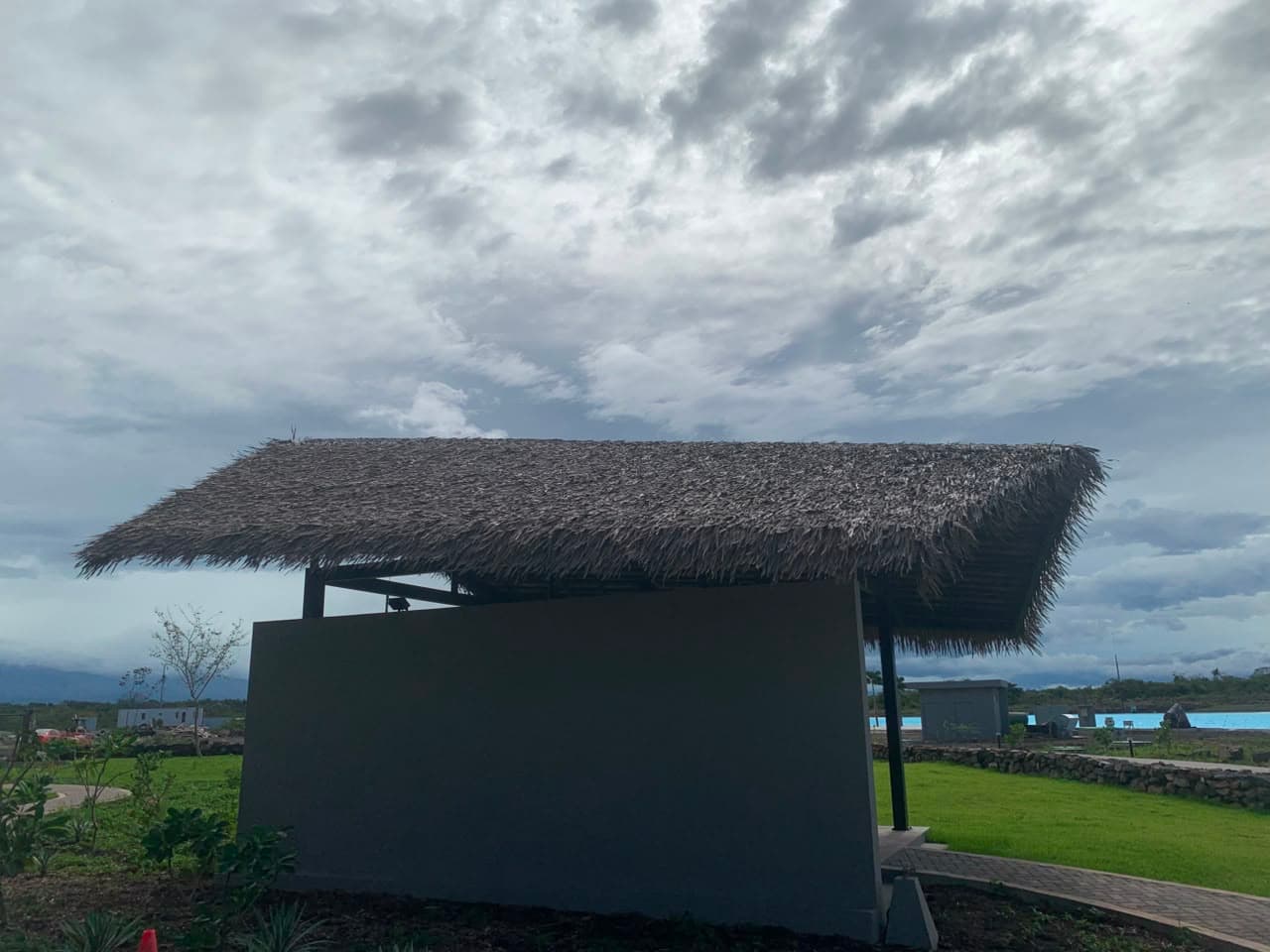
For expats and homeowners
Building your Costa Rica house from four thousand kilometres away.
What to settle before the drawings are signed, what to ask your architect for, and how a thatch roof behaves when the house is empty for months at a time.
The situation
You are making tropical decisions with temperate instincts.
Almost everything you know about roofs was learned somewhere with snow, or at least with a sun that never gets close to vertical. Costa Rica asks different questions: UV at ten degrees north, salt-laden wind, six months of serious rain, and — under natural thatch — insects, rodents and fungi that treat your roof as habitat.
None of that argues against the open-air house you came here for. It argues for deciding five or six things early, while changing your mind still costs an email rather than a change order.
- Class A ASTM E108
- 260 km/h
- 6,000 h UV ASTM G155
- 20-year warranty
It survives the months you are not there
No fibre shedding into the pool, no insect treatment cycle, nothing organic for rodents to nest in. A house that sits empty for a season comes back to you the way you left it.
Your property manager can actually maintain it
The routine is a visual check after storm season and clearing debris from valleys and gutters. That is a task you can hand over in writing, not a maintenance contract you have to supervise remotely.
It gives your insurer something to file
A roof covering tested Class A under ASTM E108 and certified to 260 km/h wind is a document. A vegetal roof cannot produce one, and some policies price that in heavily.
Working with your design team
What to send, and what to ask for back.
Send your architect the specification package
Panel data sheet, test documentation, construction details and the take-off method. Your design team in Costa Rica gets what it needs in one file, and you stop being the message relay between two technical conversations.
Ask for the roof pitch in degrees
Not “a gentle slope”. If any plane on the first roof sketch is under 18°, that is the week to raise it — after the roof plane is drawn it becomes a redesign rather than a note.
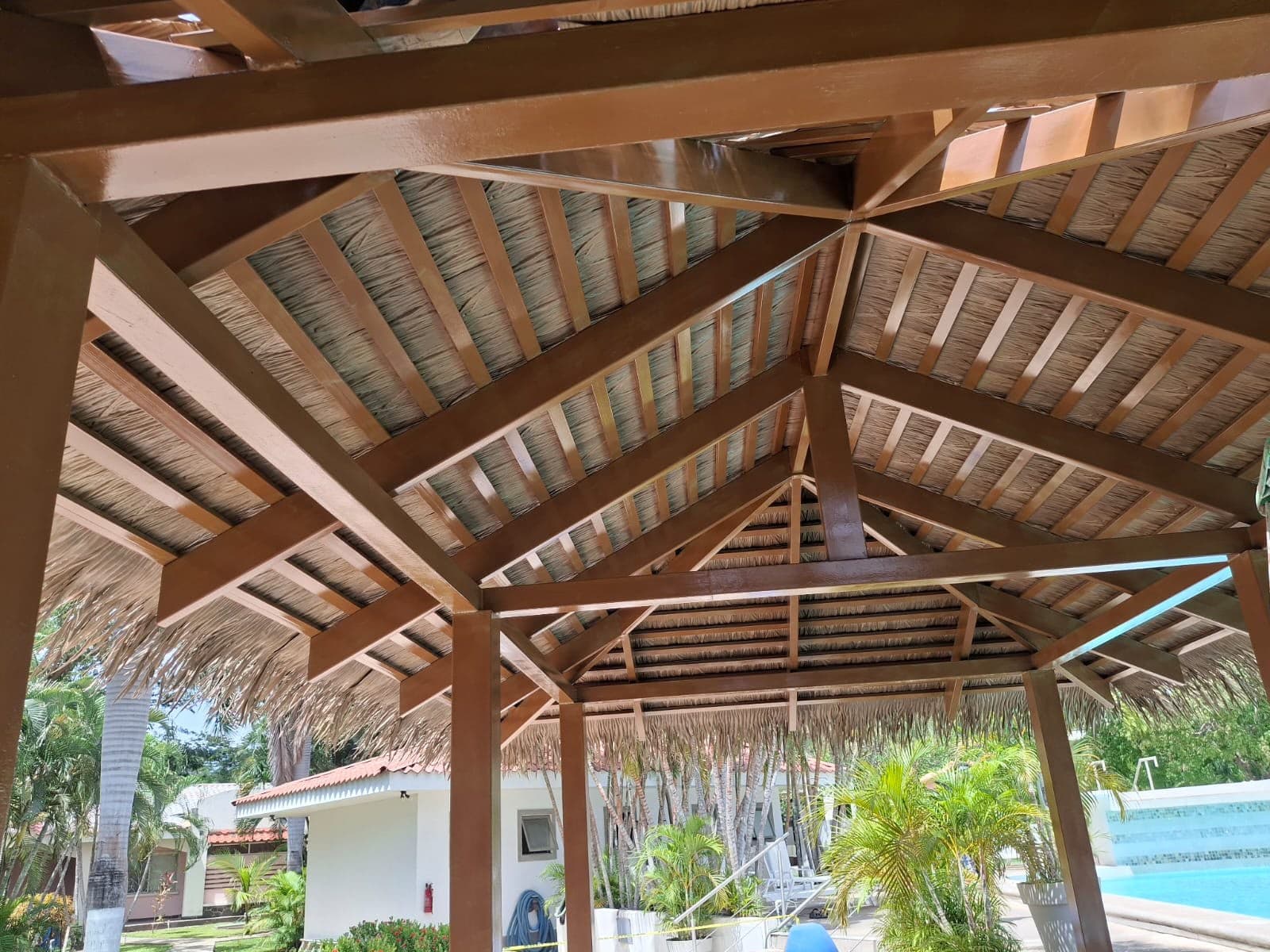
Before the drawings are signed
Four decisions that are cheap now and expensive later.
Each of these takes one conversation in schematic design and a change order once construction has started.
Amenity or main roof
A garden rancho can be added any time. A thatched living space sets the structural grid, the spans and the ceiling height of the whole house.
Pitch and drainage
18° is the working minimum, and 22° to 30° is where long planes both drain and read well. It decides the silhouette, so fix it before you fall in love with a rendering.
How deep the eaves go
The eave decides how much sun and driving rain your façade takes. With a synthetic roof a deep overhang carries no maintenance penalty, so there is no reason to be shy with it.
Fixings, if you are near the ocean
Within a few hundred metres of the Pacific everything is in a salt spray chamber. Stainless or properly coated fixings belong in the specification, not in a site decision.
Frequently asked
What homeowners ask.
We are replacing an existing palm roof. Is that harder?
It is one of the most common jobs and it is usually straightforward. The existing structure is inspected first — battens, spacing and the condition of the timber — because a new covering should not go over a structure that is already carrying rot from the old one.
Will it look artificial next to real palms in the garden?
At the distance a roof is seen from, no. The comparison people find convincing is a physical sample in hand plus a visit to a completed roof, and we arrange both — the sample by courier, the visit when you are in the country.
What happens in an earthquake?
The roof covering is a lightweight layer over battens: roughly 1 mm thick, contributing little permanent load compared with a clay or concrete tile. Seismic performance is a question for your structural engineer about the structure itself, and a lighter roof helps rather than hurts that conversation.
Can I get it in a different colour?
Tone is matched across batches so that phases and repairs blend, which is the property that matters most on a large roof. Available finishes are confirmed against current stock when your quote is prepared.
How do I pay and who is responsible for the warranty?
Supply and installation are contracted through palm.cr, the authorized NIPA® distributor in Costa Rica and part of Grupo Do It Center. The warranty letter states exactly what is covered and who issues it — worth reading before you sign anything, here or anywhere.
Send us the roof plan, whatever stage it is at.
Even a sketch is enough to tell you whether the pitch works and roughly what the roof involves.