Synthetic vs natural
Synthetic or natural thatch: an honest comparison.
Where natural palm genuinely wins, where it does not, and the specific conditions in Costa Rica that decide it either way.
Fair terms
Natural thatch is not a bad material. It is a maintained one.
A well-built vegetal roof is a genuine craft, it is locally sourced, and for the first two or three years it is beautiful in a way a manufactured product has to work hard to approach. Anyone telling you otherwise is selling something.
What it is not is low-maintenance, insurable against fire, or indifferent to being left alone for six months. In Costa Rican coastal conditions those three things decide most projects — so this page compares on them rather than on taste.
Side by side
The comparison in one table.
| Criterion | Synthetic thatch (NIPA®) | Natural palm fibre |
|---|---|---|
| Fire, roof covering test | Class A (ASTM E108) | Cannot be classified |
| Wind | Certified to 260 km/h | Frequent partial loss |
| UV exposure | 6,000 h (ASTM G155) | Visible degradation early |
| Replacement cycle | 20 years, with warranty | Re-thatch every 3–5 years |
| Insects and rodents | No organic matter to host | Habitat by definition |
| Mould and rot | Not organic | Treatment cycle required |
| Debris in pools | None | Continuous fibre shedding |
| Appearance at year one | Very close | Excellent |
| Appearance at year ten | Gradual, even tone change | Depends entirely on maintenance |
Synthetic figures are third-party test results with their scope stated. Natural fibre behaviour reflects site experience on Costa Rican coastal and Central Valley projects, not a laboratory comparison.
Where natural wins
Three cases where we would not argue.
Genuine heritage and vernacular work
Where an approving body or a cultural brief requires traditional materials and methods, that is the requirement. A synthetic panel is not a heritage material and does not pretend to be.
Short-life or temporary structures
A structure with a three-year horizon never reaches the point where the replacement cycle matters. The lifecycle argument simply does not apply.
A project with resident maintenance craft
Where there is an on-site team that maintains and re-thatches as routine work, natural fibre is being maintained rather than deferred — which is a completely different proposition from an absent owner.
The detail that surprises people
The pool is what changes minds.
Fire and wind win the technical argument. What tends to settle it in practice is the daily reality of organic material shedding over a body of water.
- Filtration
- Natural fibre sheds continuously into pools and gutters, loading filters and skimmers all year.
- Cleaning labour
- Daily rather than seasonal, and it never stops for the life of the roof.
- Storm season
- A single storm can strip enough fibre to close a pool area until it is cleared.
Frequently asked
The comparison questions.
Is synthetic thatch worse for the environment?
It is a polymer product, so it starts from a worse position than a locally harvested natural fibre. Against that, one roof over twenty years replaces four or five vegetal roofs and eliminates a recurring treatment cycle. Which way the balance falls depends on how you weigh those, and it is a fair question to ask rather than one we would wave away.
Will guests or buyers be able to tell?
At the distance a roof is viewed from, generally not. Under a lobby palapa at four metres, someone looking carefully may. Most operators regard that as an acceptable trade for a roof that never closes an area.
Can I mix the two on one property?
It happens — natural on a small feature rancho, synthetic on the buildings that matter operationally. Just be clear about which roofs have entered a maintenance cycle and which have not, so the cycle does not arrive as a surprise.
What about the traditional look of an aged palm roof?
An aged natural roof is grey, thinning and usually two years from replacement. If that specific weathered appearance is the design intent, say so early — it is an aesthetic that a warranted product deliberately does not reproduce.
Want to see both up close?
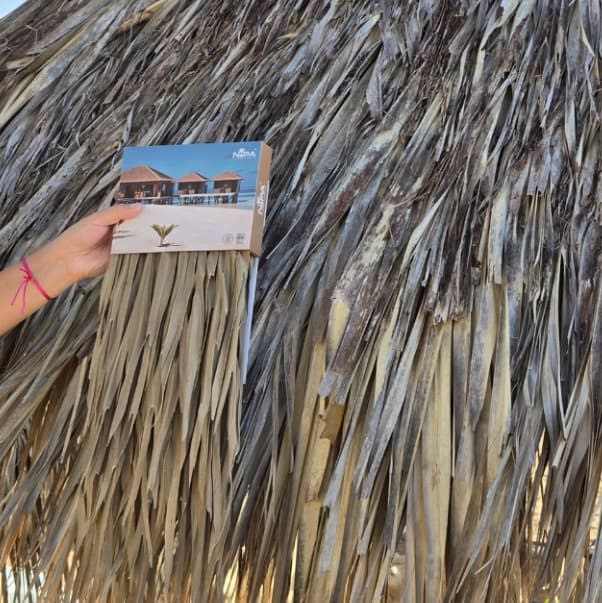
We send a physical panel sample and arrange a visit to a completed roof.