Climate6 min
Salt, sun and storm season: what a coastal roof in Guanacaste actually endures
Buyers arriving from North America or Europe tend to size a roof for rain. On the Costa Rican Pacific, rain is the easy part. These are the four loads that decide whether a roof looks the same in year twelve as it did in year one.
1. Ultraviolet radiation, close to the equator
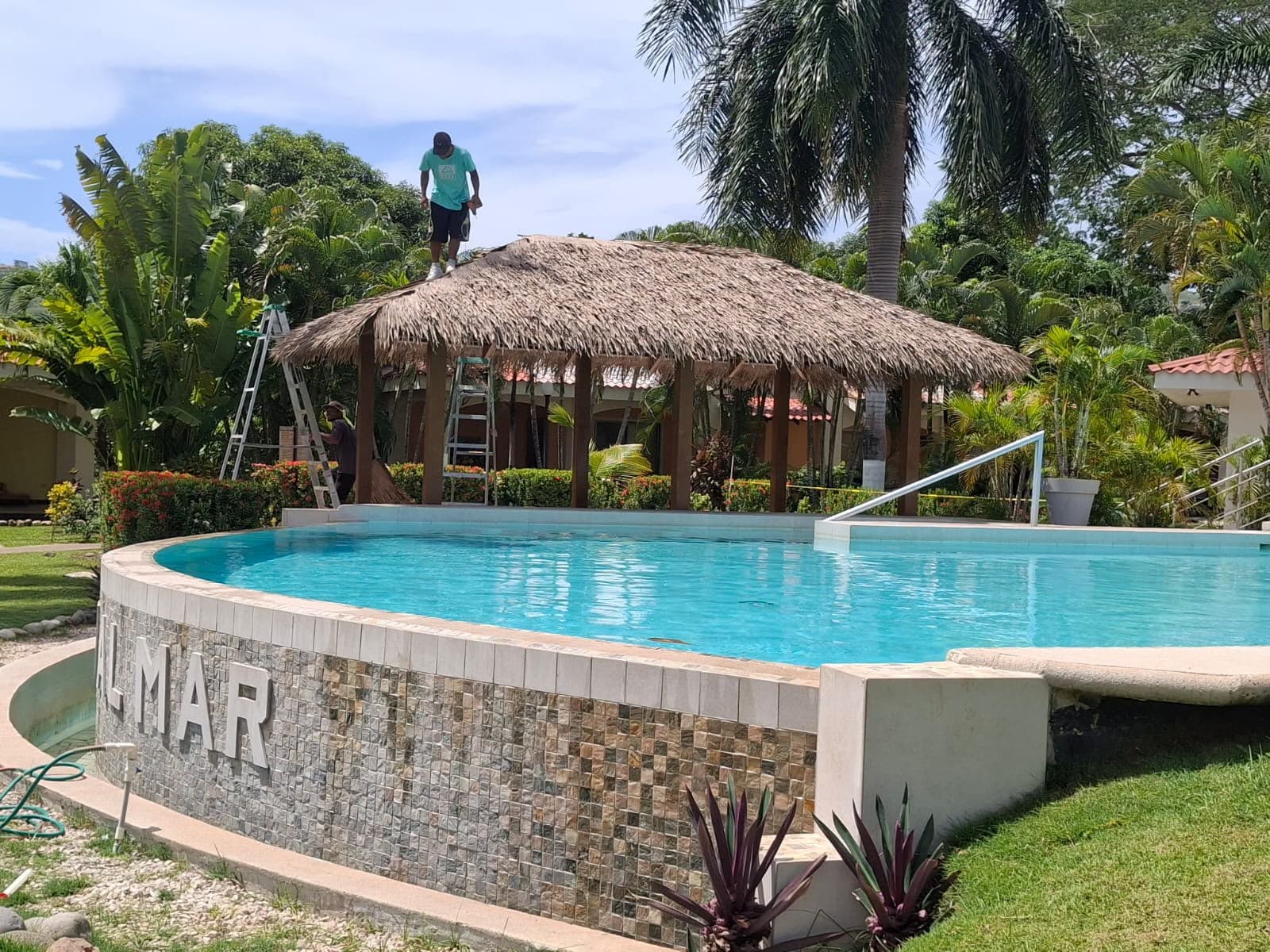
Guanacaste sits around ten degrees north. The sun is closer to vertical for more of the year than anywhere in the continental United States or Europe, and the dry season delivers months of it without meaningful cloud cover. UV is what fades pigment, embrittles polymers and turns organic fibre grey and brittle.
This is the load that accelerated testing is designed to model. The NIPA® panel is tested to 6,000 hours under ASTM G155 — roughly twelve years of intense exposure — which is why colour behaviour can be written into a warranty at all.
2. Salt-laden wind
Within a few hundred metres of the Pacific, everything is in a salt spray chamber. It is why coastal properties replace hardware, hinges and light fittings on a cycle that surprises new owners.
A synthetic thatch panel has nothing for salt to corrode, but the assembly around it does. Specify stainless or properly coated fixings on coastal work, and treat that as part of the roof specification rather than a site decision.
3. Storm season wind loads
Costa Rica sits south of the main Caribbean hurricane track, but the Pacific coast still takes the outer bands of tropical systems, and inland ridges and open beachfront sites see gusts well above the daily average.
The panel is certified to 260 km/h. What makes that figure real on your roof is the fixing pattern that goes with it: seven fixings per panel, a minimum 5 cm side lap, and battens that are square and evenly spaced.
4. Biological load
This is the one nobody mentions in the brochure. Warm, humid, organic material is habitat. A natural palm roof hosts insects, attracts rodents and grows fungi, and the standard answer is a treatment and fumigation cycle for the life of the roof.
A synthetic panel has no organic matter in it, which removes the habitat rather than managing it. For a house that sits empty part of the year, that difference compounds.
Reading a tropical roof warranty
Three questions tell you whether a warranty means anything in these conditions:
- What exactly does it cover — structural failure only, or also colour and surface degradation?
- Who issues it: the manufacturer, the distributor, or the installer who may not be trading in ten years?
- What test data stands behind each claim, and what was the scope of that test?
For the NIPA® system in Costa Rica the answer to all three is documented, and the warranty letter, test reports and data sheet are issued on request by palm.cr.